
Concrete honeycombing is a defect that occurs when voids or gaps remain within hardened concrete, often leaving a rough surface with exposed coarse aggregate. It usually develops when fresh concrete does not properly fill the available space or is not adequately compacted during placement.
Common causes include insufficient vibration, unsuitable concrete workability, poorly sealed formwork and congestion around reinforcement. While shallow honeycombing may be mainly cosmetic, deeper defects can affect durability and, in some cases, structural performance.
Understanding what causes concrete honeycombing, how to prevent it and when repairs are necessary can help avoid problems during construction.
Key Takeaways
Concrete honeycombing occurs when gaps or voids remain in hardened concrete, often creating a rough, stony appearance.
Poor compaction, unsuitable placement, reinforcement congestion and leaking formwork are common contributing factors.
Prevention relies on appropriate concrete specification and good site practices, while deeper honeycombing may require professional assessment and repair.
What is concrete honeycombing?
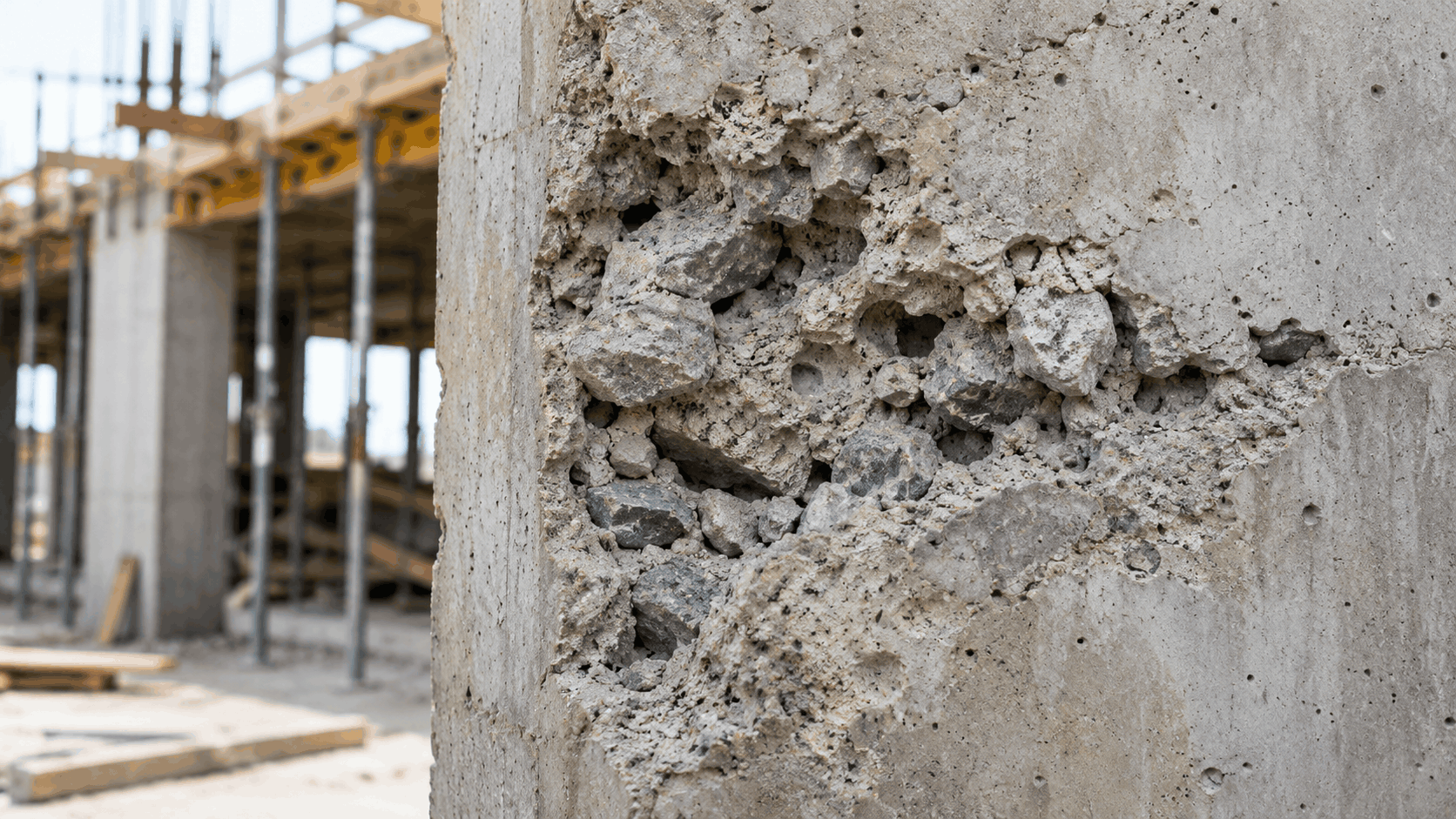
Honeycombing in concrete describes areas where the concrete has not formed a dense, uniform mass. Instead, visible gaps remain between pieces of coarse aggregate, creating a rough surface that can resemble a honeycomb.
These voids usually form while the concrete is still fresh, although they may not become visible until the formwork is removed.
Honeycombing is commonly associated with vertical concrete elements, such as walls and columns, where concrete must flow around reinforcement and fill the formwork completely. However, it can also occur in beams, foundations and other concrete structures.
The severity depends on the size, depth and location of the affected area.
Small surface voids may have little effect beyond appearance, while deeper honeycombing can reduce the effective concrete section or leave reinforcement insufficiently protected.
What does honeycombing in concrete look like?
Honeycombed concrete typically has a rough, uneven appearance, with coarse aggregate visible through gaps in the surrounding cement paste and mortar.
Common signs include:
Visible holes or cavities in hardened concrete
Exposed stones with gaps between them
Rough, irregular areas after formwork removal
Missing mortar around coarse aggregate
Voids concentrated around reinforcement
Sections where concrete appears incompletely consolidated
The appearance can vary considerably.
Some areas contain relatively shallow surface pockets, while others have deeper cavities extending into the concrete.
Not every visible hole indicates serious honeycombing. Small surface air holes, sometimes called blowholes, can occur without the larger interconnected voids associated with more significant honeycombing.
Where the depth or extent of a defect is uncertain, visual inspection alone may not establish its significance.
What causes concrete honeycombing?
Concrete honeycombing usually develops when fresh concrete fails to fill the formwork properly or when trapped air is not adequately removed during compaction.
Several factors can contribute, and more than one may be involved in the same pour.
Insufficient concrete compaction
Compaction helps fresh concrete settle into position, surround reinforcement and release trapped air.
If concrete is not compacted sufficiently, larger air pockets can remain between aggregate particles or against the formwork.
Once the concrete hardens, these pockets can become visible as honeycombing.
Mechanical vibration is commonly used to compact conventional concrete, particularly in reinforced structural elements.
However, the method must suit the concrete specification, placement conditions and formwork. Simply applying more vibration is not always the answer, as excessive vibration can cause other problems, including segregation.
Unsuitable concrete workability
Concrete needs suitable workability to move into the required position and consolidate effectively.
If a mix is too stiff for the intended placement method, it may struggle to flow around reinforcement or into narrow sections of formwork.
This can increase the likelihood of trapped air and unfilled spaces.
However, adding excessive water is not an appropriate solution. Uncontrolled water addition can alter the water-cement ratio and affect concrete strength, durability and consistency.
AMIX supplies ready mix concrete batched to order, allowing the mix specification and required workability to be considered before delivery.
Congested reinforcement
Closely spaced reinforcement can make concrete placement and compaction more difficult.
Steel bars, mesh and other embedded components create obstacles that fresh concrete must flow around.
Where reinforcement is congested, coarse aggregate may struggle to pass through narrow gaps, particularly if the concrete has unsuitable workability or aggregate characteristics.
This can leave voids behind or between the reinforcing bars.
AMIX supplies reinforced concrete for structural applications where concrete is used alongside steel reinforcement.
The reinforcement arrangement, concrete specification and placement method must be compatible with the structural design. AMIX supplies the concrete, while reinforcement is specified and installed separately.
Poor concrete placement
The way concrete is placed can influence whether it fills the formwork evenly.
Placing concrete in unsuitable layers, allowing it to fall excessively or failing to distribute it properly can contribute to segregation or incomplete consolidation.
Concrete may accumulate in one area without adequately reaching another, particularly around corners or congested reinforcement.
If compaction equipment cannot reach certain sections, trapped air may remain.
Placement should therefore be planned around the shape of the structure, reinforcement layout, available access and the concrete's specified workability.
Leaking or poorly sealed formwork
Formwork is designed to contain fresh concrete until it develops sufficient strength.
If joints are not properly sealed, cement paste or mortar can escape while the concrete is being placed.
This may leave coarse aggregate behind without enough surrounding mortar to form a dense, uniform surface.
Honeycombing can then appear around leaking joints or other vulnerable areas.
Formwork should be correctly assembled, supported and checked before concrete arrives.
Unsuitable concrete mix proportions
Concrete relies on an appropriate balance of cementitious material, water and aggregates.
A mix with insufficient fine material or unsuitable aggregate grading may lack the cohesiveness needed to fill spaces properly and remain uniform during placement.
This can increase the risk of visible voids.
Correct batching helps control the intended proportions, but successful placement and compaction remain essential.
The mix should therefore be selected for the application rather than assuming that the same concrete characteristics will suit every project.
How does poor compaction cause honeycombing?
Fresh concrete contains air that becomes trapped during mixing, transport and placement.
Compaction helps release this entrapped air and allows the concrete to settle around reinforcement and against the formwork.
Where compaction is inadequate, larger air pockets can remain inside the concrete.
These pockets may be particularly noticeable around closely spaced reinforcement, at corners or in areas where the concrete is difficult to access.
Once the concrete hardens, the remaining gaps can create honeycombing.
Correct vibration involves more than simply inserting equipment into the concrete. The vibrator must be suitable for the section being poured, used systematically and operated by someone familiar with the placement requirements.
Over-vibration should also be avoided because it can contribute to segregation in susceptible mixes.
Is honeycombing in concrete a serious problem?
Honeycombing is not always a serious structural defect, but it should not automatically be dismissed as cosmetic.
The consequences depend on several factors, including:
The depth and extent of the voids
Whether reinforcement is exposed
The location of the affected concrete
Whether the element is load-bearing
The environmental conditions
The requirements of the structural design
Small, shallow areas may have limited consequences.
However, deeper honeycombing can reduce the amount of sound concrete in a section and create pathways through which moisture or other substances may enter.
Where reinforcement is exposed or concrete cover is inadequate, durability may be affected because the steel has less protection from the surrounding concrete.
Structural elements with significant honeycombing should be assessed by an appropriately qualified engineer before repair decisions are made.
Can honeycombing weaken concrete?
Yes. Significant honeycombing can affect concrete strength and structural performance because the affected area contains voids rather than a fully consolidated mass.
The extent of the effect depends on where the honeycombing occurs and how much sound concrete is missing.
For example, a small surface defect may have little effect on a substantial concrete element, while extensive voiding in a heavily loaded section may be more concerning.
Honeycombing can also affect durability by allowing easier penetration of moisture and potentially harmful substances.
However, it is not possible to determine the structural significance of every defect from its surface appearance alone.
Professional assessment may be needed to establish the depth of the voids and whether repair, further investigation or other remedial work is required.
Where is concrete honeycombing most likely to occur?
Honeycombing can develop wherever fresh concrete is difficult to place or compact properly.
Areas that may be particularly vulnerable include:
Reinforced concrete columns
Concrete beams with congested reinforcement
Wall corners and formwork joints
Deep or narrow structural sections
Foundations with complex reinforcement arrangements
Retaining walls and other formed concrete elements
For example, a reinforced retaining wall may contain substantial reinforcement and require concrete to be placed within relatively confined formwork.
AMIX supplies concrete for retaining walls for domestic and commercial applications where strength and stability are important.
The concrete specification, reinforcement layout and construction method should be coordinated before the pour to help achieve adequate placement and compaction.
How can concrete honeycombing be prevented?
Preventing honeycombing begins before concrete arrives on site.
The aim is to ensure that the specified concrete can be placed and compacted effectively throughout the structure.
Choose concrete with suitable workability
Concrete should be specified according to the application, reinforcement, formwork and placement method.
A mix that is suitable for an open slab may not have the same placement requirements as a narrow, heavily reinforced section.
Where particular workability is needed, this should be discussed with the concrete supplier before ordering.
Uncontrolled water should not be added on site to compensate for an unsuitable specification.
Prepare and inspect the formwork
Formwork should be secure, correctly aligned and adequately sealed.
Before the pour, check that joints are sufficiently tight to prevent significant mortar leakage.
The formwork should also be clear of debris and suitable for the intended placement and compaction method.
Where reinforcement is present, access for placing and vibrating the concrete should be considered.
Plan the placement sequence
Concrete should be placed in a controlled manner that allows it to fill the formwork without unnecessary segregation.
The appropriate placement method and layer depth depend on the concrete and structural arrangement.
Planning is particularly important where reinforcement or restricted access makes certain sections difficult to reach.
Sufficient labour and suitable equipment should be available before delivery begins.
Compact the concrete correctly
Appropriate compaction is one of the most important ways to reduce honeycombing.
For conventional vibrated concrete, the equipment should be suitable for the section and used systematically to help remove trapped air.
The operator should avoid missing areas, particularly around reinforcement and formwork corners.
Excessive vibration should also be avoided.
Compaction methods should follow the concrete specification and construction requirements rather than relying on a single approach for every pour.
Coordinate delivery and site preparation
Concrete placement should begin with the site ready to receive the material.
Delays, restricted access and inadequate equipment can make the pour more difficult and increase the risk of poor placement practices.
Before delivery, confirm that formwork, reinforcement, access arrangements, labour and compaction equipment are ready.
Where a project has complex placement requirements, these should be discussed during planning rather than after the concrete reaches site.
How is honeycombing in concrete repaired?
Concrete honeycomb repair depends on the extent of the defect and whether it affects the durability or structural performance of the element.
A repair should not begin simply because an area looks rough.
The first step is to assess the affected concrete and determine whether the voids are shallow or extend deeper into the section.
For relatively minor, non-structural defects, an appropriate repair material may be used after the affected area has been prepared.
More significant honeycombing may require removal of unsound concrete and reinstatement using a suitable repair system.
Where reinforcement is exposed, the condition of the steel and the adequacy of concrete cover also need to be considered.
The repair material, preparation method and curing requirements should be selected by a competent repair specialist. Structural repairs should follow the relevant engineer's specification.
AMIX supplies concrete rather than undertaking specialist concrete repair work.
Can you repair honeycombing yourself?
Minor cosmetic defects may sometimes be suitable for straightforward surface repairs, but it is important to establish that the problem is genuinely superficial.
A small visible opening does not necessarily reveal the full extent of the voiding behind it.
Simply filling the surface with mortar may conceal deeper cavities without addressing the underlying problem.
If honeycombing affects a structural element, exposes reinforcement or appears extensive, professional assessment is advisable.
A qualified specialist can determine whether the affected concrete needs further investigation and identify a suitable repair approach.
Can honeycombing be prevented with ready mix concrete?
Using appropriately specified ready mix concrete can help provide consistent material proportions and workability for the intended application.
However, ready mix concrete does not automatically prevent honeycombing.
Even correctly batched concrete can develop defects if it is poorly placed, inadequately compacted or allowed to lose mortar through leaking formwork.
Preventing honeycombing therefore requires both suitable concrete and good construction practices.
AMIX supplies concrete batched to order for domestic and commercial projects across the North West, helping customers select mixes suited to their requirements.
The contractor remains responsible for correct placement, compaction and curing on site.
What should you do if you discover honeycombing?
If honeycombing becomes visible after formwork removal, avoid immediately covering it with a surface repair.
First, consider the location and extent of the affected area.
Where the concrete is load-bearing, the voids appear deep or reinforcement is exposed, the defect should be reported to the responsible contractor or engineer.
The affected section may need further investigation to establish whether the problem is limited to the surface.
Any repair should then follow an appropriate assessment and specification.
This helps ensure that a visible defect is not simply concealed while a more significant problem remains.
Speak to the AMIX team about your concrete requirements
Preventing honeycombing starts with specifying concrete that suits the project and preparing the site for correct placement.
AMIX supplies ready mix concrete across the North West for domestic and commercial applications, including foundations, slabs, walls and reinforced concrete construction.
If you are planning a concrete pour, speak to the AMIX team about the required specification, workability, quantity, site access and delivery arrangements.
The team can help you choose an appropriate concrete supply option, while structural design, placement, compaction and specialist repairs should be managed by the relevant qualified professionals.
Frequently asked questions
-
Honeycombing is a defect where gaps or voids remain between coarse aggregate particles in hardened concrete. It commonly results from incomplete placement, insufficient compaction, unsuitable workability or mortar loss through formwork joints.
-
Inadequate compaction is a common cause, but honeycombing can also result from unsuitable concrete workability, congested reinforcement, poor placement or leaking formwork. Several factors may contribute to the same defect.
-
Not always. Small, shallow areas may be mainly cosmetic, while extensive or deep honeycombing can affect durability and structural performance. Honeycombing around reinforcement or within a load-bearing element should be assessed by a qualified professional.
-
Yes, many honeycombing defects can be repaired, but the appropriate method depends on their depth, location and severity. Structural defects require assessment and a suitable repair specification rather than simply filling visible holes.
-
Not necessarily throughout the entire element. Honeycombing can create local areas of reduced density and strength, but the significance depends on the extent and location of the voids. Professional investigation may be needed to establish the impact.
-
Use concrete with suitable workability, prepare and seal formwork correctly, plan placement around reinforcement and compact the concrete appropriately. Good site preparation and controlled placement help reduce the risk of trapped air and unfilled spaces.