
Concrete spalling: What causes it and how can it be prevented?
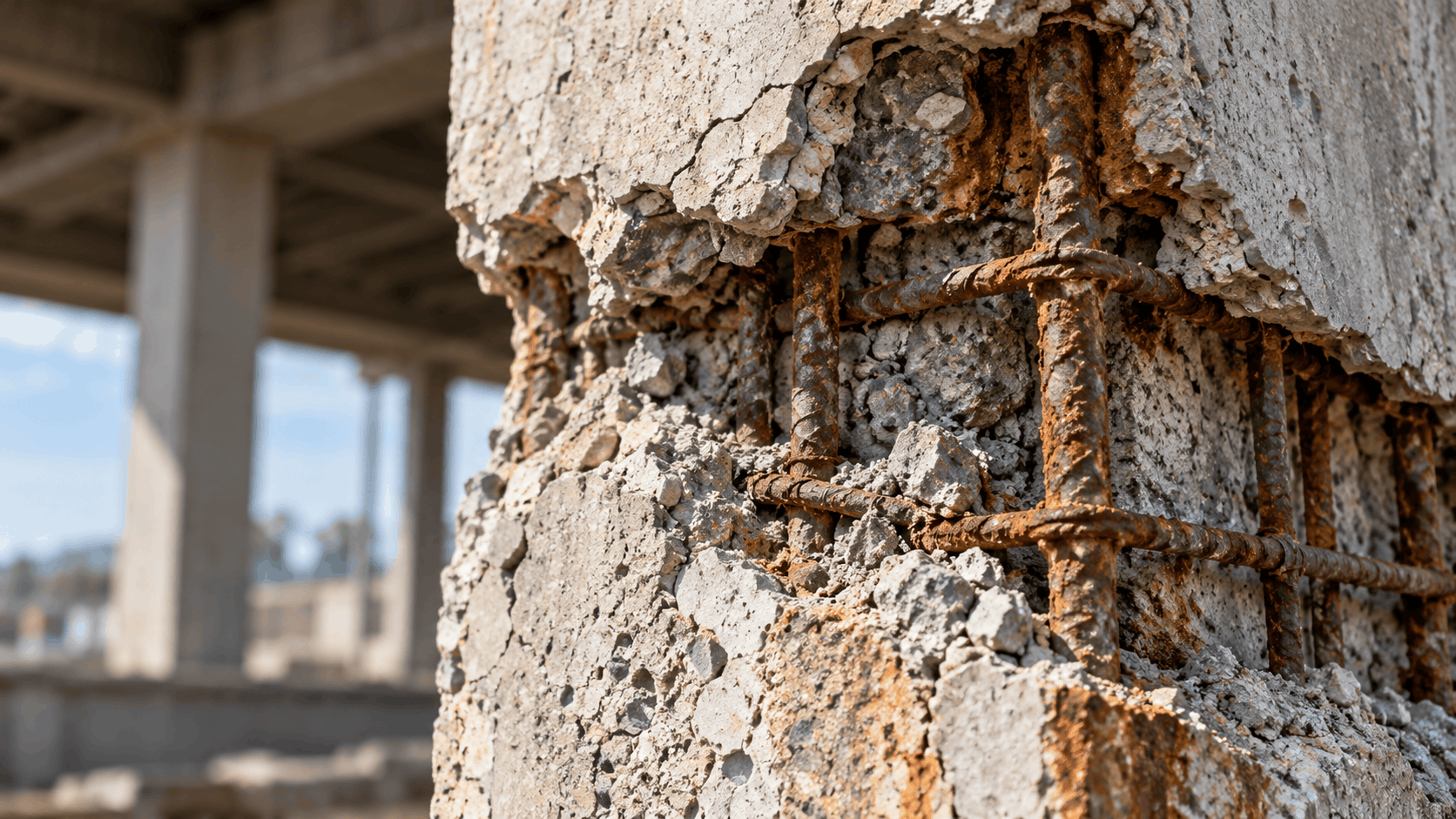
Concrete spalling happens when parts of a concrete surface begin to flake, chip or break away. In more serious cases, the deterioration can expose coarse aggregate or the steel reinforcement within the concrete.
There is no single cause of concrete spalling. Reinforcement corrosion, freeze-thaw exposure, inadequate concrete cover, unsuitable concrete, poor compaction and problems during placement or curing can all contribute.
Identifying why concrete is spalling is important because repairing the visible surface without addressing the underlying cause may only provide a temporary solution. Good concrete specification and construction practices can also help reduce the risk of spalling developing in new concrete.
Key Takeaways
- Concrete spalling occurs when areas of hardened concrete flake, chip or break away from the surface.
- Common causes include reinforcement corrosion, freeze-thaw damage and problems with concrete specification, placement or curing.
- Prevention starts with the correct concrete specification, good construction practices and appropriate protection for the conditions the concrete will face.
What is concrete spalling?
Concrete spalling is a form of deterioration in which material breaks away from the surface of hardened concrete.
The severity can vary considerably. Early deterioration may appear as small chips, pits or areas of flaking. More advanced spalling can result in larger pieces of concrete becoming detached and may expose aggregate or reinforcement beneath the surface.
Spalling can affect concrete slabs, floors, walls, columns and other concrete elements.
It is important to distinguish significant spalling from minor cosmetic damage. Where deterioration is extensive, reinforcement is exposed or there are concerns about a structural concrete element, the concrete should be assessed by an appropriately qualified professional.
What does spalling concrete look like?
Spalling concrete can have a rough, broken or pitted appearance.
Typical signs can include:
- Flaking or chipping at the surface
- Small pits or depressions
- Larger areas of concrete breaking away
- Exposed coarse aggregate
- Cracks around affected areas
- Exposed steel reinforcement
- Rust staining around reinforcement
The appearance can provide clues, but it does not necessarily reveal the exact cause.
For example, shallow surface deterioration may have a different cause from deeper spalling around corroding reinforcement. The location, depth and extent of the damage therefore need to be considered before deciding what action is required.
What causes concrete spalling?
Concrete spalling can result from several different deterioration mechanisms.
Common causes and contributing factors include reinforcement corrosion, repeated freeze-thaw exposure, inadequate concrete cover, poor compaction, unsuitable concrete, poor curing, excessive water, chemical exposure and physical damage.
More than one factor can sometimes be involved.
For example, moisture entering reinforced concrete may contribute to corrosion of the embedded steel. Expansion associated with corrosion can then place pressure on the surrounding concrete, eventually causing sections of the cover to crack and detach.
Understanding the underlying cause is therefore essential when assessing existing spalling.
How does reinforcement corrosion cause concrete spalling?
Corrosion of embedded steel is an important cause of spalling in reinforced concrete.
Concrete normally provides an alkaline environment that helps protect embedded steel. Over time, processes such as carbonation can reduce this protection. Chlorides can also contribute to reinforcement corrosion in suitable conditions.
When steel corrodes, the corrosion products occupy more volume than the original steel. This expansion creates pressure against the surrounding concrete.
Cracking can develop along the reinforcement before sections of the concrete cover eventually loosen or break away.
AMIX supplies reinforced concrete designed for use alongside structural reinforcement such as steel bars or mesh. The reinforcement itself is specified and installed separately by the contractor or engineer according to the structural design.
What is carbonation in concrete?
Carbonation is a natural process in which carbon dioxide from the atmosphere enters concrete and reacts with compounds within it.
Over time, this reduces the alkalinity of the affected concrete.
This matters in reinforced structures because the naturally alkaline environment of concrete helps protect embedded steel from corrosion. If carbonation reaches the reinforcement and sufficient moisture and oxygen are present, corrosion can become possible.
Carbonation does not mean concrete will immediately start spalling. The rate and consequences depend on factors including concrete quality, cover depth and exposure.
Where spalling appears around reinforcement, professional investigation may be needed to establish whether corrosion is responsible.
Can freeze-thaw cycles cause concrete spalling?
Yes. Repeated freezing and thawing can contribute to deterioration where concrete is exposed to moisture and freezing temperatures.
Concrete contains pores that can hold water. When this water freezes, it expands and creates internal pressure.
Repeated cycles can progressively damage susceptible concrete and contribute to surface scaling, flaking or spalling.
External concrete is naturally more exposed to weather than many internal applications, so the concrete specification needs to suit its intended environment.
Drainage, placement, finishing and curing can also influence long-term performance. Selecting an appropriate concrete mix is therefore only one part of producing durable external concrete.
Is spalling the same as concrete scaling?
The terms can sometimes be used loosely, but they are useful to distinguish.
Scaling generally describes relatively shallow deterioration of a concrete surface, where the surface mortar flakes or peels away.
Spalling can describe deeper loss of concrete and may expose coarse aggregate or reinforcement.
Both can indicate deterioration, but their causes and severity can differ.
The distinction becomes particularly important when reinforcement is exposed or when deterioration affects a structural element. In these situations, treating the problem as a simple cosmetic surface defect may overlook a more significant underlying issue.
Can too much water contribute to concrete deterioration?
The amount of water in a concrete mix needs to be properly controlled.
Adding excessive water can alter the water-cement ratio and may increase porosity while reducing the strength and durability the concrete was intended to achieve. It can also contribute to increased shrinkage and other problems.
Water should therefore not simply be added on site because concrete appears difficult to place.
AMIX supplies ready mix concrete batched to order and delivered ready for use. Producing concrete at a batching facility allows the constituent materials to be measured under controlled conditions rather than relying on repeated manual mixing at the project site.
How can poor compaction contribute to spalling?
Fresh concrete needs to be properly placed and compacted for the application.
Insufficient compaction can leave voids and areas where the concrete has not fully consolidated. In reinforced concrete, this can be particularly problematic around steel reinforcement.
Voids can reduce the quality of the concrete surrounding the steel and provide less effective protection from environmental exposure.
The correct compaction method depends on the concrete, formwork, reinforcement and structure being constructed.
Placement and compaction should therefore be planned before concrete arrives, particularly for structural pours or sections containing closely spaced reinforcement.
Why does concrete cover matter?
Concrete cover is the distance between embedded reinforcement and the external surface of the concrete.
Adequate cover helps protect reinforcement from environmental exposure and contributes to the durability and fire performance of reinforced concrete.
If reinforcement is positioned too close to the surface, the level of protection may be reduced.
The required cover depends on the structural design and exposure conditions. It should therefore be established by the relevant project specification rather than estimated during placement.
AMIX supplies the concrete mix, while structural reinforcement and its positioning are specified and installed separately by the contractor or engineer.
Can poor curing contribute to surface deterioration?
Curing is an important part of concrete construction.
Concrete develops strength through hydration after it has been placed. Suitable moisture and temperature conditions need to be maintained during this early period.
If the concrete surface loses moisture too quickly, its development can be affected. Poor curing can contribute to weaker surface characteristics, shrinkage cracking and reduced durability.
Weather conditions should therefore be considered before the pour. Warm, dry or windy conditions can increase moisture loss, while cold conditions create different challenges.
The contractor responsible for placement should have an appropriate curing method planned before concrete arrives.
Can spalling concrete be dangerous?
The seriousness of spalling depends on its location, depth and cause.
Small areas of shallow surface deterioration may primarily affect appearance or usability. Deeper spalling can be more significant, particularly where reinforcement has become exposed.
Detached pieces of concrete can also create hazards depending on where the affected concrete is located.
Spalling affecting structural slabs, columns, walls, balconies or other load-bearing elements should not simply be treated as a cosmetic issue.
If reinforcement is exposed, cracking is progressing, concrete is becoming detached or there are concerns about structural integrity, an appropriately qualified professional should assess the affected area.
Can spalled concrete be repaired?
Spalled concrete can often be repaired, but the correct repair depends on why the deterioration occurred.
Loose or unsound concrete may need to be removed before an appropriate repair material is applied. Where reinforcement corrosion is involved, simply covering the steel again without addressing the corrosion may allow the deterioration to continue.
The extent of the damage also matters.
A small area of non-structural surface deterioration requires a different approach from widespread spalling affecting reinforced structural concrete.
AMIX supplies concrete rather than providing concrete repair or structural assessment services. Significant or structural deterioration should be assessed and repaired by suitably qualified professionals.
How can concrete spalling be prevented?
There is no single method that can prevent every possible form of spalling.
Reducing the risk begins with specifying concrete that is appropriate for the project and the conditions it will face.
Good construction practice can include:
- Selecting the appropriate concrete specification
- Preparing the site and sub-base correctly
- Following specified reinforcement and concrete cover requirements
- Avoiding uncontrolled water addition
- Placing and compacting concrete correctly
- Using appropriate finishing methods
- Curing concrete properly
- Providing suitable drainage and detailing
- Protecting concrete appropriately for its exposure conditions
Long-term durability depends on the complete concrete installation rather than one individual factor.
Preventing problems with concrete slabs and floors
Good preparation is particularly important when constructing horizontal concrete surfaces.
AMIX supplies concrete for slabs and floors for applications including garage floors, base slabs, internal floors, workshops and outbuildings.
The appropriate concrete mix depends on factors such as the expected load, whether the slab is internal or external, ground preparation, reinforcement and the required finish.
Before the pour, the sub-base should be properly prepared, formwork should be secure and any required reinforcement or membrane should be ready.
The concrete should then be placed, compacted, finished and cured correctly for the project.
Does reinforced concrete prevent spalling?
Reinforcement does not make concrete immune to spalling.
Steel reinforcement provides tensile capacity as part of a properly designed reinforced concrete element, while the surrounding concrete provides compressive strength and protection for the reinforcement.
If conditions allow the steel to corrode, however, the resulting expansion can itself become a cause of spalling.
This is why reinforced concrete construction requires more than simply placing steel inside a concrete slab.
Concrete specification, reinforcement positioning, cover, compaction, curing and exposure conditions all need to be considered as part of the design and construction process.
Does concrete quality matter?
The concrete specification and consistency are important starting points for durable construction.
AMIX produces ready mix concrete at a batching facility and batches concrete to order. The company supplies concrete for applications including foundations, slabs, footings, driveways, floors and general construction.
AMIX can also supply specified mixes, with its Concrete & Services information listing mixes ranging from GEN1 to RC50 and fibres or admixtures available on request.
However, properly batched concrete still needs to be installed correctly.
Site preparation, placement, compaction, finishing and curing can all influence the performance of the finished concrete.
Why site preparation matters
The pour area should be ready before concrete arrives.
For a slab or floor, this can include preparing and compacting the sub-base, securing formwork and installing any membranes or reinforcement required by the design.
Access should be clear and sufficient labour and equipment should be available for placement.
AMIX advises that concrete should normally be placed promptly following delivery to help maintain workability and achieve the required finish.
Planning the pour in advance helps reduce unnecessary delays and allows the concrete to be placed and finished while it has the characteristics intended for the job.
Choosing concrete for long-term performance
Concrete should be specified for the application and environment in which it will be used.
A general domestic base, external slab and structural reinforced element can have different performance requirements.
Factors such as loading, exposure, reinforcement, finish and setting requirements may all affect the concrete specification.
AMIX supplies a range of concrete types for domestic and commercial applications, including standard, fibre reinforced, reinforced, paving and high early strength concrete.
Where a project has engineering or structural requirements, the concrete ordered should follow the relevant specification rather than relying on a general-purpose mix.
Speak to the AMIX team
AMIX has supplied ready mix concrete across the North West since 1993 and works with domestic customers, builders and contractors.
Concrete is batched to order and delivered ready for placement, with different mixes available to suit a range of applications.
If you are planning a new concrete project, the AMIX team can discuss the application, quantity, access and delivery requirements to help identify a suitable concrete option.
Where structural requirements, reinforcement details or specific exposure conditions apply, these should be established by the relevant engineer or suitably qualified professional before the concrete is ordered.
Frequently asked questions
What is concrete spalling?
Concrete spalling is deterioration where sections of hardened concrete flake, chip or break away. More significant spalling can expose coarse aggregate or steel reinforcement beneath the surface.
What are the main causes of concrete spalling?
Possible causes include reinforcement corrosion, freeze-thaw deterioration, inadequate concrete cover, poor compaction, unsuitable concrete, poor curing, excessive water, chemical exposure and physical damage. The exact cause needs to be established before an appropriate repair is chosen.
What is the difference between concrete spalling and scaling?
Scaling generally affects the surface layer of concrete and can cause shallow flaking or peeling. Spalling can involve deeper loss of concrete and may expose coarse aggregate or reinforcement.
Does exposed reinforcement mean concrete spalling is serious?
Exposed reinforcement can indicate deeper deterioration and should not be ignored. Where reinforcement is visible, corrosion is present or the concrete forms part of a structural element, an appropriately qualified professional should assess the damage.
Can concrete spalling be repaired?
Often, yes. However, the repair needs to address the underlying cause as well as the visible damage. Where reinforcement corrosion or structural deterioration is involved, professional assessment and an appropriate repair specification may be required.
How can you help prevent concrete spalling?
Risk can be reduced through appropriate concrete specification, correct reinforcement cover, controlled water content, proper placement and compaction, suitable finishing and effective curing. Drainage, detailing and exposure conditions should also be considered.