
Concrete segregation: What is it, what causes it and how can it be prevented?
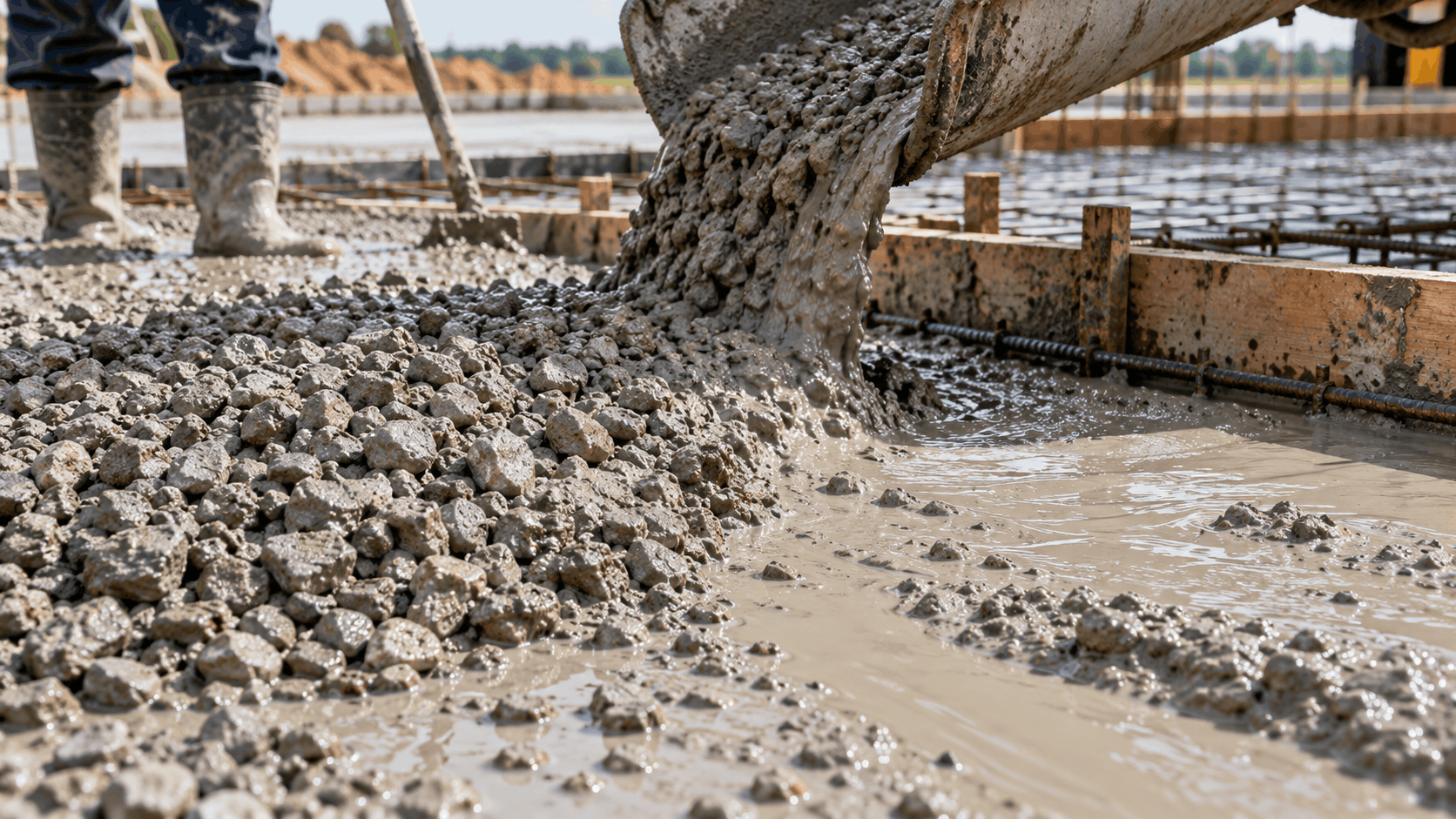
Segregation of concrete happens when the constituent materials in fresh concrete separate instead of remaining evenly distributed throughout the mix.
Because concrete relies on cementitious material, water and aggregates working together in the correct proportions, segregation can create areas with different compositions and properties. This can affect the consistency, finish, strength and durability of the hardened concrete.
Segregation can occur during handling, transportation or placement. Excessive water, unsuitable handling, dropping concrete from excessive heights and incorrect compaction practices can all increase the risk.
Understanding what causes concrete segregation is therefore important for achieving a consistent pour and avoiding preventable defects.
Key takeaways
- Segregation of concrete occurs when the constituent materials in fresh concrete separate and the mix becomes non-uniform.
- Excessive water, poor handling, unsuitable placement and incorrect vibration can all contribute to segregation.
- Correct concrete specification, controlled batching and good handling, placement and compaction practices help reduce the risk.
What is segregation of concrete?
Concrete is made from materials with different particle sizes and densities. A properly proportioned and mixed concrete should remain sufficiently uniform while it is transported, placed and compacted.
Segregation occurs when that uniformity is lost.
One common form involves coarse aggregate separating from the mortar or cement paste. Heavier aggregate may settle or become concentrated in one area, leaving other areas with a higher proportion of paste.
This can create an inconsistent finished concrete rather than a uniform material throughout the pour.
Segregation is primarily a concern while concrete is fresh. However, its effects can remain after the concrete has hardened.
What does segregated concrete look like?
Signs of segregation can sometimes be visible while the concrete is being handled or placed.
Coarse aggregate may appear to collect in particular areas while mortar or cement paste becomes concentrated elsewhere. The mix may appear uneven rather than cohesive.
Once hardened, problems associated with poor consolidation or material separation can include:
- Uneven surface texture
- Areas containing noticeably more coarse aggregate
- Voids within the concrete
- Honeycombing
- Poorly consolidated sections
- An inconsistent finish
Not every void or surface defect automatically proves that segregation occurred. Problems with formwork, placement and compaction can produce similar visible defects.
The cause should therefore be considered rather than diagnosed solely from appearance.
What causes segregation in concrete?
Segregation can occur for several reasons, and more than one factor may contribute during the same pour.
Common causes include:
- Unsuitable mix proportions
- Excessive water
- Poor handling of fresh concrete
- Allowing concrete to fall an excessive distance during placement
- Incorrect or excessive vibration
- Poor placement techniques
- Delays or unsuitable handling between mixing and placement
The characteristics of the concrete also matter. A mix needs sufficient cohesiveness to keep its constituent materials distributed during normal handling and placement.
Correct specification should therefore be considered alongside good site practices.
Can too much water cause concrete segregation?
Excessive water can increase the risk of segregation by making a concrete mix less cohesive.
Water content is an important part of concrete mix design. Adding uncontrolled quantities of water on site changes the proportions of the concrete and can affect the water-cement ratio, workability, strength and durability.
A very wet mix may appear easier to place initially, but increasing workability by simply adding water is not a suitable substitute for ordering concrete with the characteristics required for the job.
AMIX supplies ready mix concrete that is batched to order at its plant and delivered ready for use. Controlled batching allows the constituent materials to be measured as part of the specified mix before the concrete reaches site.
Can concrete segregate during placement?
Yes. Concrete can be properly mixed and still be affected by poor handling or placement practices.
Dropping fresh concrete from an excessive height can encourage the heavier coarse aggregate to separate from the mortar.
Concrete should instead be placed using methods appropriate for the formwork, reinforcement, access and type of pour.
Placement should also be organised so that concrete can be distributed and compacted effectively rather than being deposited in a way that encourages separation.
For more complicated structural pours, the placement method should be planned before delivery so suitable equipment and labour are available when the concrete arrives.
Can vibration cause concrete segregation?
Vibration is commonly used to consolidate fresh concrete and remove entrapped air, but it needs to be carried out correctly.
Insufficient compaction can leave voids and poorly consolidated areas. Excessive vibration, however, can encourage heavier aggregate particles to settle while lighter components move upwards, particularly where the concrete is already highly workable.
This means more vibration is not automatically better.
The appropriate method and duration depend on the concrete, formwork, reinforcement and type of element being constructed.
Compaction should therefore be undertaken using suitable equipment and techniques for the particular pour.
What is the difference between segregation and bleeding?
Segregation and bleeding are related fresh-concrete issues, but they are not exactly the same.
Segregation describes separation of the constituent materials within the concrete, such as coarse aggregate separating from the mortar.
Bleeding involves water moving upwards towards the surface as solid particles settle within fresh concrete.
Some bleeding can occur naturally in concrete, but excessive bleeding can contribute to surface and finishing problems.
Both issues highlight why concrete proportions, handling and placement practices matter. However, seeing water at the surface does not necessarily mean the entire concrete mix has segregated.
Is segregation the same as honeycombing?
No. Segregation and honeycombing describe different things, although they can sometimes be associated.
Segregation occurs when the components of fresh concrete separate.
Honeycombing describes voids or cavities visible in hardened concrete, often with coarse aggregate exposed and insufficient mortar filling the spaces between particles.
Honeycombing can result from factors such as inadequate compaction, difficult placement around reinforcement or poor filling of the formwork. Segregation may also contribute in some circumstances.
It is therefore more accurate to treat honeycombing as a defect that can have several possible causes rather than assuming segregation is always responsible.
How does segregation affect concrete?
Concrete is designed to perform as a relatively uniform composite material.
If its components separate significantly, different parts of the finished concrete may no longer contain the intended distribution of aggregate and paste.
This can result in:
- Areas of inconsistent concrete
- Voids or poorly consolidated sections
- An uneven surface or finish
- Localised weak areas
- Increased permeability in affected areas
- Reduced durability
The significance depends on the extent of the segregation and where it occurs.
Suspected segregation affecting structural concrete should be assessed appropriately rather than simply covered with a surface treatment.
Does concrete segregation reduce strength?
Significant segregation can result in areas of concrete that do not have the composition intended by the mix design.
This can create localised differences in performance and may reduce the quality of the finished element.
It is therefore better to prevent segregation during handling and placement than attempt to deal with its effects after the concrete has hardened.
Where defects are discovered in structural concrete, their significance should be assessed by an appropriately qualified professional. The appearance of the concrete alone is not enough to determine its structural capacity.
How can concrete segregation be prevented?
Preventing segregation requires attention to the concrete itself and to how it is handled once it reaches site.
Good practice can include:
- Using concrete specified for the application
- Maintaining the intended mix proportions
- Avoiding uncontrolled addition of water
- Handling fresh concrete carefully
- Using suitable placement equipment
- Avoiding excessive free fall during placement
- Placing concrete systematically
- Compacting concrete correctly
- Avoiding excessive vibration
- Preparing labour, access and equipment before delivery
The exact requirements depend on the type of pour.
Structural elements, heavily reinforced sections, slabs and straightforward domestic pours can present different placement challenges, so the method should be appropriate for the project.
Why controlled batching matters
Consistent concrete begins before the mixer truck reaches the site.
AMIX batches concrete at its plant and supplies it ready for placement. Its delivery information states that each load is individually batched to order to help maintain consistent strength and workability.
This reduces the need to proportion and mix individual concrete ingredients manually on the construction site.
For general construction work, AMIX also supplies standard concrete mixed to order for applications including foundations, slabs and footings.
Controlled batching does not remove the need for good site practices. Once concrete arrives, correct handling, placement, compaction, finishing and curing remain important to the quality of the completed work.
Why preparation before concrete delivery matters
Concrete placement should be planned before the mixer arrives.
Formwork should be prepared and secure, the pour area should be ready, access should be clear and sufficient labour should be available.
Any required reinforcement should also be installed in accordance with the project design before placement begins.
AMIX’s concrete delivery guidance states that concrete should normally be placed promptly after delivery to help maintain workability and achieve the required finish.
Planning ahead reduces avoidable delays and means the team can concentrate on placing and compacting the concrete appropriately rather than preparing the site after the concrete has arrived.
Can concrete segregate inside a mixer truck?
A mixer truck is designed to transport concrete while maintaining the material in a workable condition, but correct delivery and handling remain important.
Concrete characteristics change with time after batching, which is one reason the pour area should be ready before delivery.
Once the concrete arrives, it should be handled and placed appropriately rather than subjected to unnecessary delays or uncontrolled changes to the mix.
If there are concerns about the concrete on arrival, these should be raised before placement rather than attempting to alter the mix without appropriate guidance.
Does a more workable concrete prevent segregation?
Not necessarily.
Workability describes how easily fresh concrete can be mixed, handled, placed and compacted. The required workability depends on the application and placement method.
A mix that is too stiff for the intended placement can create difficulties, but simply making concrete wetter is not the correct solution.
Excessive water can reduce cohesiveness and increase the risk of segregation while also changing other concrete properties.
Where a project has particular placement requirements, the required concrete characteristics should be considered when the concrete is specified and ordered.
What should you do if concrete appears to be segregating?
If fresh concrete appears to be separating significantly during placement, continuing without considering the cause may result in defects in the finished work.
The handling and placement method should be reviewed, including whether concrete is being dropped too far, moved unnecessarily or vibrated incorrectly.
Uncontrolled water should not be added in an attempt to correct the problem.
Where there is uncertainty about the suitability or condition of delivered concrete, the supplier should be contacted for guidance before making changes to the mix.
For structural work, decisions about accepting, removing or assessing affected concrete may also require input from the relevant engineer or suitably qualified professional.
Choosing the right concrete for the project
The appropriate concrete depends on what is being built and the performance required from the finished element.
AMIX supplies concrete for domestic and commercial applications including foundations, slabs, footings, driveways, groundworks and reinforced concrete work.
Different projects can require different strengths, workability characteristics, setting behaviour or specialist concrete types.
Choosing the appropriate specification before the pour helps ensure the concrete is suitable for the intended application and placement conditions.
Where engineering or structural requirements apply, the concrete should follow the project specification.
Good concrete still needs good site practices
Professionally batched concrete provides a controlled starting point, but the finished result also depends on what happens on site.
Preparation, handling, placement, compaction, finishing and curing all have a role in producing satisfactory concrete.
Segregation is a good example of why these stages matter. Concrete can lose uniformity if it is handled or placed incorrectly even when the materials were correctly proportioned during batching.
The supplier, contractor and project team therefore have different roles in helping the concrete perform as intended.
Speak to the AMIX team
AMIX has supplied ready mix concrete across the North West since 1993, supporting domestic and commercial projects.
Concrete is batched to order and delivered ready for placement, with different concrete types available for a range of applications.
If you are planning a pour, speak to the AMIX team about the application, required quantity, access and delivery arrangements.
For projects with structural or engineering requirements, the relevant concrete specification should be confirmed by the appropriate engineer or suitably qualified professional before ordering.
Frequently asked questions
What is segregation of concrete?
Segregation of concrete is the separation of constituent materials within fresh concrete. It can result in coarse aggregate, mortar or other components becoming unevenly distributed rather than remaining uniform throughout the mix.
What are the main causes of concrete segregation?
Potential causes include excessive water, unsuitable mix proportions, poor handling, excessive free fall during placement and incorrect or excessive vibration. Several factors can contribute during the same pour.
What are the signs of concrete segregation?
Fresh concrete may appear uneven, with coarse aggregate accumulating in particular areas. After hardening, affected concrete may show inconsistent texture, exposed aggregate, voids or poorly consolidated areas. These signs can have other causes, so appearance alone does not confirm segregation.
What is the difference between bleeding and segregation in concrete?
Segregation involves separation of the constituent materials within fresh concrete. Bleeding specifically involves water rising towards the surface as solid particles settle. They are related fresh-concrete behaviours but are not the same defect.
Can excessive vibration cause concrete segregation?
Yes. Although vibration is used to consolidate concrete, excessive vibration can encourage heavier aggregate to settle and contribute to separation, particularly in highly workable concrete. Compaction should be appropriate for the mix and type of pour.
How can segregation of concrete be prevented?
Risk can be reduced through correct concrete specification, controlled water content, careful handling, appropriate placement, avoiding excessive free fall and using suitable compaction methods. The site should also be prepared before delivery so concrete can be placed promptly and efficiently.